
The Impact of Water-Cooled Exhaust And Supercharging on The Engine
Recently, news of a technological innovation emerged in China’s rail transit sector—a comprehensive transformation plan for old hydraulic locomotives was officially released. This plan upgrades the traditional high-energy-consuming hydraulic drive system (Diesel engine drive) to a Hybrid drive (Battery sets + Diesel engine) or Full electrical drive, achieving a comprehensive green upgrade from drive method to energy management. This provides an efficient, economical, and environmentally friendly transformation path for locomotives used in mining, railway, and subway engineering.
Addressing Industry Pain Points and Promoting Green Equipment Transformation
Currently, a large number of in-service hydraulic locomotives face prominent problems such as aging equipment, high energy consumption, high emissions and noise, and rising maintenance costs. Some core components have been discontinued, leading to long maintenance cycles and difficulties in spare parts supply. This transformation plan was developed to address these issues, aiming to help users revitalize existing assets through technological upgrades, achieving a leapfrog improvement in equipment performance and energy efficiency at only 30%-50% of the cost of purchasing new electric locomotives.
The technical solution is mature and reliable, enabling multi-dimensional upgrades.
The modification retains the main locomotive structure, removing core components such as the original diesel engine and hydraulic transmission box, replacing them with a low-power diesel generator set, a large-capacity power battery pack, a traction converter, and a high-efficiency electric motor drive system. The modified locomotive has multiple operating modes: pure electric drive, pure diesel engine drive, and hybrid drive, and supports ground charging, on-board charging, and regenerative braking, significantly improving operational flexibility.
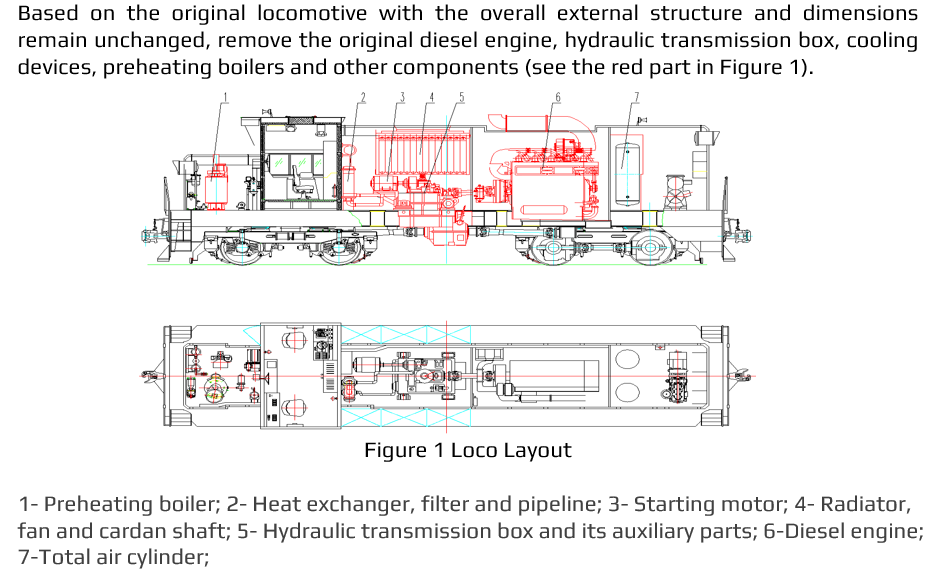
The solution also reserves interfaces and installation space for intelligent functions such as video monitoring, unmanned driving, and remote control, laying the foundation for the locomotive’s digital management and future upgrades.
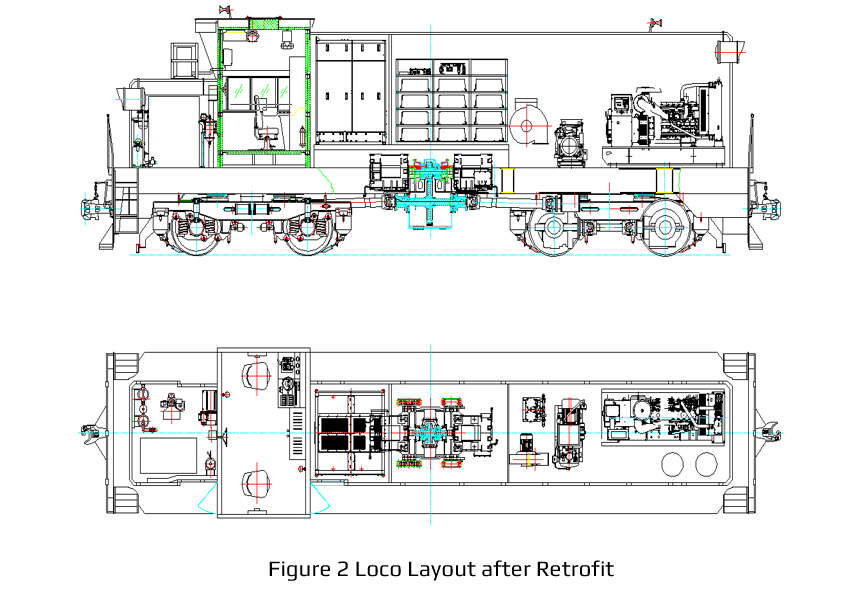
Significant economic and environmental benefits.
According to calculations, the operating cost of a single locomotive is significantly reduced after the modification. In actual application data, the fuel saving rate is as high as 91% when using ground charging mode, and even when using the on-board diesel generator, the fuel saving rate reaches 47%. At the same time, due to the new system’s long maintenance cycle and low failure rate, annual maintenance costs can be saved by approximately 250,000 yuan. In summary, a single locomotive can generate a comprehensive economic benefit of over 460,000 yuan annually.
In terms of environmental protection, the locomotive operates in a “zero-emission” pure electric state most of the time, reducing overall exhaust emissions by 60% to 90%, meeting advanced emission standards such as China’s National V standard and European and American Tier 2/3 standards. Operating noise is reduced by over 80%, with cab noise below 72 decibels, significantly improving the working environment for drivers and passengers as well as the surrounding community environment.
The successful launch of this locomotive retrofit program provides an economically feasible “green rebirth” path for a large number of outdated or inefficient hydraulic transmission locomotives facing obsolescence. It is not only a technological upgrade but also a powerful practice in promoting the “dual-carbon” goals and implementing green development in the rail transit sector, indicating that the industry is steadily moving towards a cleaner, smarter, and more efficient direction.

Sales Team Generator - SinoGen Marine - SeaMac Automotive - DuraMac Railways - RailMac Industrial - ConeMac Pump - PumpMac Fire - Pump - PumpMac EV System - EVMac Parts - PartMac Sales Manager - Mrs. Wendy Fu Sales Director - Mr. Jasper Lee Shipping Service


Contact EMAC Now!