
Corvus Energy, a leading provider of zero-emission solutions for the maritime industry, has announced that it will supply an ultra-large battery energy storage system (BESS) for the world’s first all-electric offshore vessel, marking a new phase in the clean energy transition for ship propulsion.
The vessel, an electric Commissioning Service Operation Vessel (eCSOV), is being built by Spanish shipyard Armón for U.K. shipowner Bibby Marine Limited. It will be the first fully electric offshore vessel capable of operating entirely on battery power.
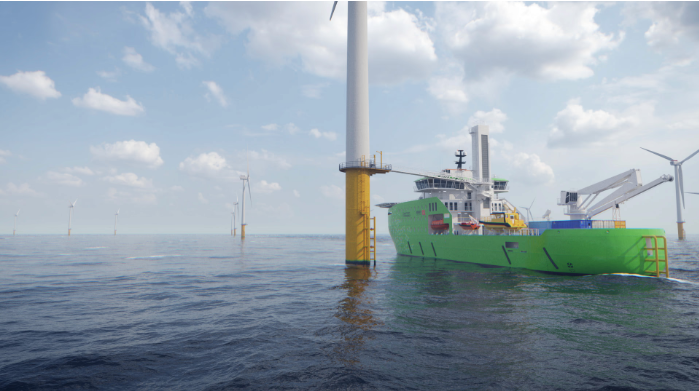
Pioneering Power System Sets New Industry Benchmark
Corvus Energy will equip the vessel with its flagship “Blue Whale” BESS, with a total capacity of nearly 25 MWh, making it the largest lithium iron phosphate (LFP) battery project in the maritime sector to date.
“The all-electric offshore vessel has long been a goal for the industry, and its realization will fundamentally transform offshore operations,” said Pål Ove Husoy, Sales Vice President of Corvus Energy. “This eCSOV is not only the first offshore vessel capable of operating solely on battery power around the clock but also incorporates a hybrid system design that combines high-capacity batteries with dual-fuel methanol engines. This ensures reliability for demanding tasks such as offshore wind farm operations while enabling low-carbon and highly efficient performance.”
Innovative Power Distribution Design Enhances Overall Performance
For this project, Corvus Energy worked closely with the shipowner, design company, and system integrator to optimize the system capacity. Unlike traditional hybrid systems, this vessel will primarily rely on its large battery pack for power, with the engines operating only within the optimal load range to recharge the batteries. This approach maximizes system efficiency, extends battery life, and significantly reduces emissions.
The innovative DC grid architecture further optimizes energy distribution, minimizing power loss and enabling seamless electricity management to enhance overall system performance. Notably, the vessel also introduces the capability for charging while performing offshore operations, allowing the batteries to be replenished even when using dynamic positioning (DP) systems—a first in the SOV market.


Accelerating the Shipping Industry’s Path to Net Zero
“We are thrilled to collaborate with Corvus Energy on this groundbreaking eCSOV project,” said Gavin Foard, Newbuilding Director at Bibby Marine. “It not only sets a new standard for sustainable offshore operations but also drives the future development of zero-emission vessel technology.”
He added that Corvus Energy was selected for its proven track record in delivering complex marine projects, while LFP battery technology was chosen for its high safety, long lifespan, and exceptional reliability—attributes that align perfectly with the operational profile of the eCSOV. This project is expected to play a key role in accelerating the maritime industry’s journey toward net-zero emissions.
According to the plan, Corvus Energy’s equipment will be delivered to the shipyard in 2026, and the vessel is expected to enter service in 2027, supporting the construction and operation of offshore wind farms.


